Showing posts with label ShamelessSelfPromotion. Show all posts

Monday, 17 October 2011

Upcoming talks and travels

I'm going to be up to a number of things that may be of interest to the readers of this (rather sparse) blog.

Quick summary


Our workshop (other co-chairs are Amélie Anglade, Òscar Celma, Paul Lamere, and Brian McFee) will cover a diverse array of approaches and angles for music recommendation and discovery. The workshop is runs the full and is part of RecSys 2011, though I sadly can't stay for most of the conference aside from our workshop (see below). It should prove to be an interesting day of research. Are you planning on attending? Let us know.


I'll be dashing off from Chicago to Miami to attend ISMIR, and to present some new (not-yet-released) API features from Musicmetric. While things aren't quite live yet, I can say that in addition to our artist based endpoints, we'll be offering track-based endpoints soon as well, and aligning them with an I-bet-you-can-guess-which large public audio feature test set. More detail on this one to come.


Ignite is a series of lightning talks that have taken place in cities all over the world, unified not by a common theme, but a common format: all talks last five minutes, contain 20 slides, and the slides are automatically advanced every 15 seconds. The matching ethos of this structure is perhaps best seen in the Ignite slogan, "Enlighten us, but make it quick." I'll be speaking about beer, style and critical tasting in a talk titled "Ale or Lager and Other False Choices." Here's a brief description:
In a word, my talk is about beer. In a few more words, the driving narrative behind the talk is a crash course in beer styles and more generally, critical tasting. After an extraordinarily brief description of beer, broad ideas of style and the critical tasting process, the core of the talk will be made up of live lightning tastes of commercial examples of various styles of beer (one slide per style, 12 styles covered with one commercial example each). For coherence these tasting slides will grouped into broader styles, with aim toward width, rather than depth of coverage. The styles will be approximately based on those from the BJCP and the Brewer's Association.
I still haven't sorted out the exact spread of beers or how they will be grouped, though I'm leaning toward something simple and obviously ingredient tied (something like -- Lagers, ales:yeast driven, ales:malt forward, ales:hop heavy, with 3 beers each from a different recognized style in each). If anyone has any thoughts about style divisions or specific examples do let me know. If you'd like to go to ignite (and you know you would) the tickets will be available over this way later this week.


So, lots of things going on. Plus there's this other thing I've been working on.

Right, back to it.

Saturday, 29 May 2010

publications on playlists in ISMIR

So for this year's ISMIR I'll be doing another tutorial. This one is entitled "Finding A Path Through The Jukebox – The Playlist Tutorial" and I'll be presenting it with Paul Lamere. As you may have guessed by the title it's all about playlists. So to frame some of my background work I thought I'd poke around the ISMIR proceedings to get a more complete idea of all of the papers that dealt with topic across the 10 years of proceedings (plus the just announced titles from this year).

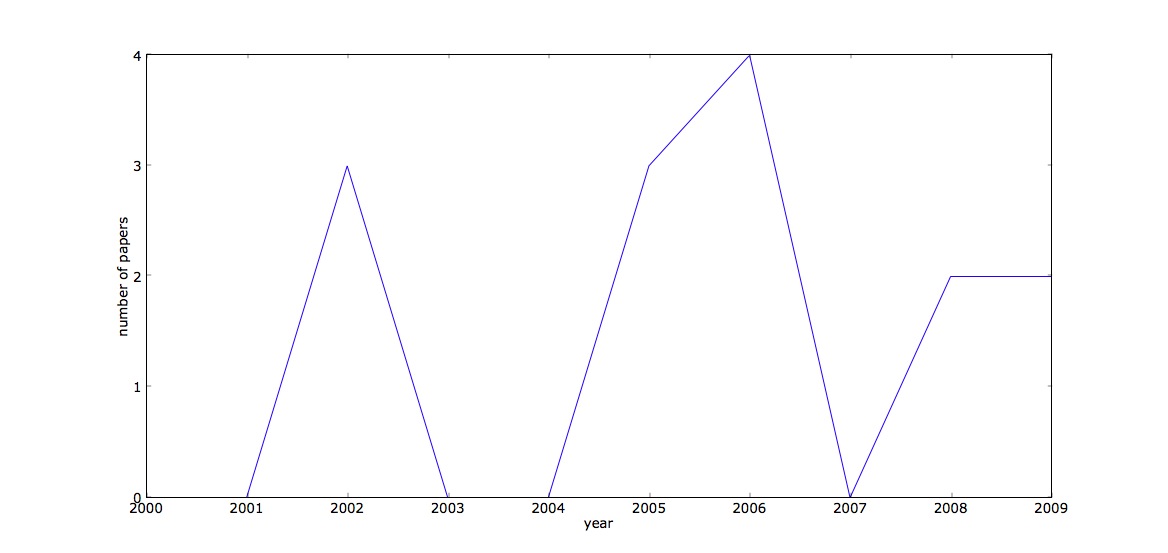
First I did a simple title search using the tool at ismir.net. This shows that from 2000 - 2009 there were 14 papers with 'playlist' occurring somewhere in the title. Here they are over time:


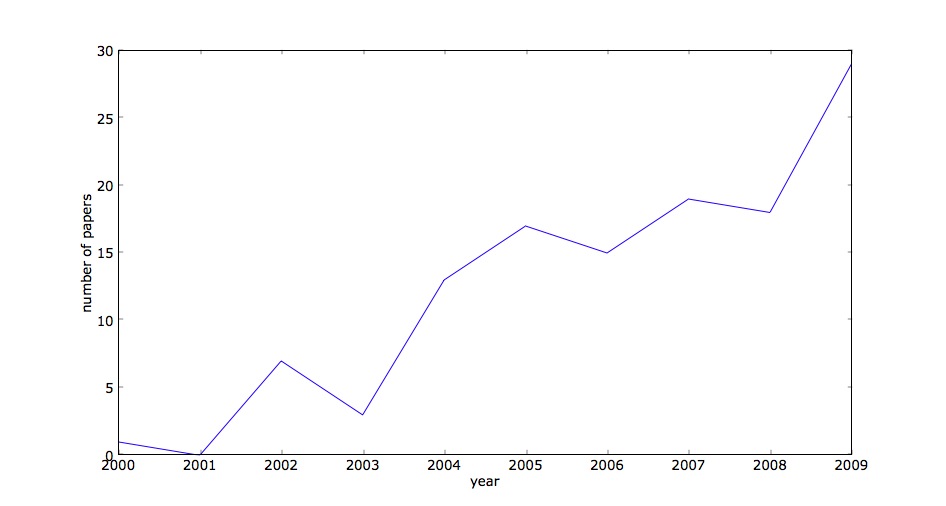
Well, that doesn't show very much, just some interest, no trends or anything. So from there I took a look at the results of at the text search available from Rainer Typke's website. The full text search found some 123 papers mentioning playlist, certainly a few more than the title search. From there I wanted to see what the distribution of these papers was over time (as above), though this took a bit more work, as I couldn't sort out a means to export the search results... Anyway after a bit of counting I got this:

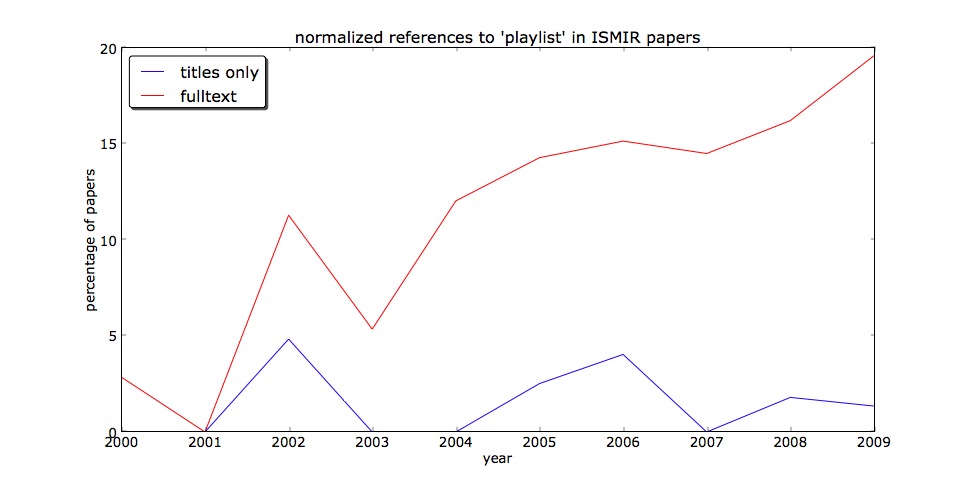
Well, now we're getting somewhere! Clearly there's an increasing number of papers discussing playlists at ISMIR. But wait, you say, this doesn't take into account the considerable expansion of the size of the conference over it's existence. So we can normalize to the number of papers per year that are known the the Cumulative ISMIR proceedings ( [35, 43, 62, 56, 108, 119, 99, 131, 111, 148] from 2000 - 2009 if anyone is interested). Below you can see both the title only and full paper search results normalized to the total number of papers:

The normalization didn't seem to change the trend much. But this leaves me wondering, what can be drawn from the the massive (and growing) disparity between title mentions and fulltext mentions? Obviously one would expect a higher number of hits, but a tenfold increase, seems very large. My first suspicion is that a great deal of this disparity comes from the fact that many papers at ISMIR that mention playlists are actually about something else (music similarity for instance) and then throw on a playlist as something of an afterthought. Perhaps this is an implicit acknowledgment of the great human-factor power of the playlist (as discussed in for instance this paper) or perhaps it's something else entirely.

Regardless of these finer points, it's clearly fair to say that there is a great deal of interest in playlist generation and analysis. If you're interested in these things, why not sign up for our tutorial?

Monday, 1 March 2010

IEEE-THEMES --shameless self promotion--

I'm going to be presenting work at IEEE-THEMES, a workshop collocated with ICASSP, on March 15th in Dallas, TX. The talk is associated with an article to be published in the august issue of Select Topics in Signal Processing, which is a special issue on signal processing and social networks. Here's the title/abstract (note: link is to a preprint, camera-ready isn't due till after the talk so paper may well change a touch...) :


Abstract—This paper presents an extensive analysis of a sample of a social network of musicians. The network sample is first analyzed using standard complex network techniques to verify that it has similar properties to other web-derived complex networks. Content-based pairwise dissimilarity values between the musical data associated with the network sample are computed, and the relation- ship between those content-based distances and distances from network theory explored. Following this exploration, hybrid graphs and distance measures are constructed, and used to examine the community structure of the artist network. Finally, results of these investigations are presented and considered in the light of recommendation and discovery applications with these hybrid measures as their basis.
The paper mostly covers content that has been discussed elsewhere (much of it with Kurt Jacobson) refactored for a broader audience and with wider narratives in mind. That said there are some notable new findings in the paper as well. We have run another acoustic dissimilarity measure across the entire set (the 2009 MIREX entry in audio music similarity using marsyas) which for the most part confirms our earlier findings (that acoustic similarity and social similarity [mostly] aren't linearly correlated and that community genre labeling becomes more homogeneous [again, mostly] when using the audio sim as a weight). Additionally, we have broadened our comparison metrics to include an examination of the mutual information between the different dissimilarity sets. This also basically confirms our earlier findings, though mutual information provides a very satisfying level of nuance that is not possible from simply testing (using Pearsons) for linear correlation, especially given that our data is quite far from a normal distribution. So, if you're planning to be at ICASSP, I'd highly recommend IEEE-THEMES (the rest of the program looks to be very interesting as well...) and if you aren't going to be in Dallas, there are a few options for you.
  1. If you're in London right now, you can come to Goldsmiths today at 4pm to rm 144 in the main building, where I'll be giving a trail run of the talk.
  2. Slides (and perhaps some video) will be made available at some point (probably just after the talk is given).
  3. IEEE is running a pay-to-watch live stream of THEMES, so there's that as well.
Generally, if you're going to be in Dallas fr0m March 15-19, much discussion can happen in person. Also, between now and then I'll be doing some traveling (tomorrow till 6 March I'll be at UIUC, then from there till the 14th of March I'll be in San Diego) so if any readers are interested in some in person discussion and our locations overlap, let me know and perhaps something can be arranged.